
Achilles tendon Achilles Tendinopathy: Why Does My Achilles Hurt When I Run?pain
Achilles pain is one of the most common problems we see in runners.
It can start as a slight stiffness at the back of the ankle when you get out of bed, or a niggle during the first few minutes of a run. But if it is ignored, that mild irritation can gradually become persistent enough to affect running, walking and even everyday activities.
The good news is that most Achilles tendon problems can be successfully managed without surgery.
At Wandsworth Physiotherapy, we take a multidisciplinary approach to Achilles pain. Depending on your symptoms, this may include specialist physiotherapy and rehabilitation, diagnostic ultrasound, shockwave therapy, podiatry, gait assessment and advice on footwear and training.
The important first step is understanding exactly what is causing your pain.
What is the Achilles tendon?
The Achilles is the large, strong tendon at the back of your ankle.
It connects the calf muscles – primarily the gastrocnemius and soleus – to the heel bone (calcaneus).
Every time you walk, run, jump or push up onto your toes, the Achilles tendon helps transfer force from your calf to your foot.
Running places particularly high loads through the Achilles, which is why the tendon needs to be both strong and capable of repeatedly storing and releasing energy.
Normally, a healthy tendon adapts to this loading and becomes stronger.
Problems tend to develop when the amount of load placed through the tendon exceeds its current ability to tolerate and recover from it.
What is Achilles tendinopathy?
Achilles tendinopathy is the term we use to describe persistent pain and dysfunction associated with the Achilles tendon.
You may previously have heard this called Achilles tendinitis. We now know that persistent Achilles pain isn’t simply an inflammatory condition, so “tendinopathy” is generally a more appropriate term.
The tendon can gradually change in response to excessive or poorly managed loading. Its normal collagen structure may become less organised and the tendon can become thicker.
Importantly, though, changes within a tendon don’t always equal pain.
It is possible to see changes on an ultrasound scan in someone who has no Achilles symptoms at all. This is one reason why we don’t treat a scan result in isolation – we need to combine imaging with your symptoms, history and physical examination.
Who gets Achilles tendinopathy and Achilles Pain?
Runners are particularly susceptible to Achilles Pain, but Achilles tendinopathy doesn’t only affect runners.
We also see it in people who participate in sports involving repeated running and jumping, including:
- Football
- Tennis and padel
- Hockey
- Rugby
- Athletics
- CrossFit
- Gym and HIIT training
It can also affect people who aren’t particularly sporty.
Age can play a role because tendons gradually change as we get older, and Achilles tendinopathy is common among active middle-aged adults.
Why has my Achilles suddenly started hurting?
Often there isn’t one dramatic injury.
Instead, we commonly hear:
“I haven’t done anything to it – it just started hurting.”
When we look more closely, there is frequently a change in loading somewhere in the preceding days or weeks.
You might have:
- Increased your weekly running mileage
- Started marathon or half-marathon training
- Added more speed or interval sessions
- Started running more hills
- Changed your running surface
- Returned to running after a break
- Increased gym or plyometric training
- Done a long weekend walk or hike
- Changed your footwear
- Started playing a new sport
- Suddenly increased your overall activity levels
A tendon that was coping perfectly well with three runs a week may not be ready for five runs, a hill session and a weekend football match.
It isn’t necessarily that running has “damaged” your tendon. More often, there is a mismatch between the load you’re asking the tendon to tolerate and its current capacity to tolerate that load.
That distinction is important because rehabilitation is largely about gradually rebuilding that capacity.
Mid-portion vs insertional Achilles tendinopathy
Not all Achilles pain is the same.
There are two particularly common forms of Achilles tendinopathy.
Mid-portion Achilles tendinopathy
This causes pain and tenderness in the main body of the tendon, usually a few centimetres above the heel.
You may notice a visible or palpable thickening or “bump” within the tendon.
Some runners find they can actually run reasonably well once they have warmed up – but their Achilles is significantly more painful later that day or the following morning.
That delayed response is important when deciding how much training your tendon is currently tolerating.
Insertional Achilles tendinopathy
Insertional Achilles tendinopathy affects the lower part of the tendon where it attaches to the heel bone.
Pain is therefore usually felt directly at the back of the heel rather than higher up the tendon.
Compression can play a bigger role with insertional problems. For example, the tendon is compressed against the heel bone when the ankle moves into deeper dorsiflexion.
This means some traditional Achilles exercises, particularly heel drops performed over the edge of a step, may actually aggravate insertional symptoms.
This is why getting the correct diagnosis matters. The rehabilitation programme needs to be adapted to the particular part of the tendon involved.
Typical symptoms of Achilles Pain include:
- Morning stiffness
- Pain during your first few steps after getting out of bed
- Tenderness when you squeeze the tendon
- Stiffness after sitting for a while
- Pain at the beginning of a run
- Symptoms that sometimes improve as you warm up
- Pain or stiffness after running
- Reduced ability to push up onto your toes
Is all pain at the back of the ankle Achilles tendinopathy?
No – and this is another reason why an assessment can be valuable.
Pain around the Achilles and heel can potentially be associated with:
- Achilles tendinopathy
- Partial Achilles tendon tear
- Achilles tendon rupture
- Paratenon-related problems
- Retrocalcaneal bursitis
- Plantaris-related pain
- Haglund’s deformity
- Other ankle or foot problems
- Inflammatory conditions
A sudden severe pain accompanied by a snap or sensation of being kicked in the back of the ankle needs immediate assessment, particularly if you subsequently struggle to walk or push up onto your toes.
This can indicate an Achilles tendon rupture rather than tendinopathy, and requires urgent treatment.
How is Achilles tendinopathy diagnosed?
Achilles tendinopathy is primarily a clinical diagnosis.
At Wandsworth Physiotherapy, your assessment will normally start with a detailed discussion about your symptoms.
We may ask:
- When did the pain start?
- Was there a specific injury?
- Where exactly is the pain?
- Is your Achilles stiff in the morning?
- Does it hurt when you start running?
- What happens as you warm up?
- How does it feel later that day or the next morning?
- Has your running volume or intensity recently changed?
- Have you changed your shoes?
- Have you recently returned from injury or a break from running?
We’ll then assess the tendon itself as well as looking at factors such as ankle movement, calf strength and your ability to perform a calf raise.
For runners, we may also need to consider the whole kinetic chain rather than focusing exclusively on the painful tendon.
Do I need an ultrasound scan for Achilles pain?
Not everybody does.
A straightforward Achilles tendinopathy can often be diagnosed from your symptoms and physical examination without imaging.
However, diagnostic ultrasound can be extremely useful when we want more information about the tendon, particularly if the diagnosis isn’t completely clear, symptoms have persisted despite appropriate rehabilitation, there is concern about a tear or another condition, or we’re considering certain additional treatments.
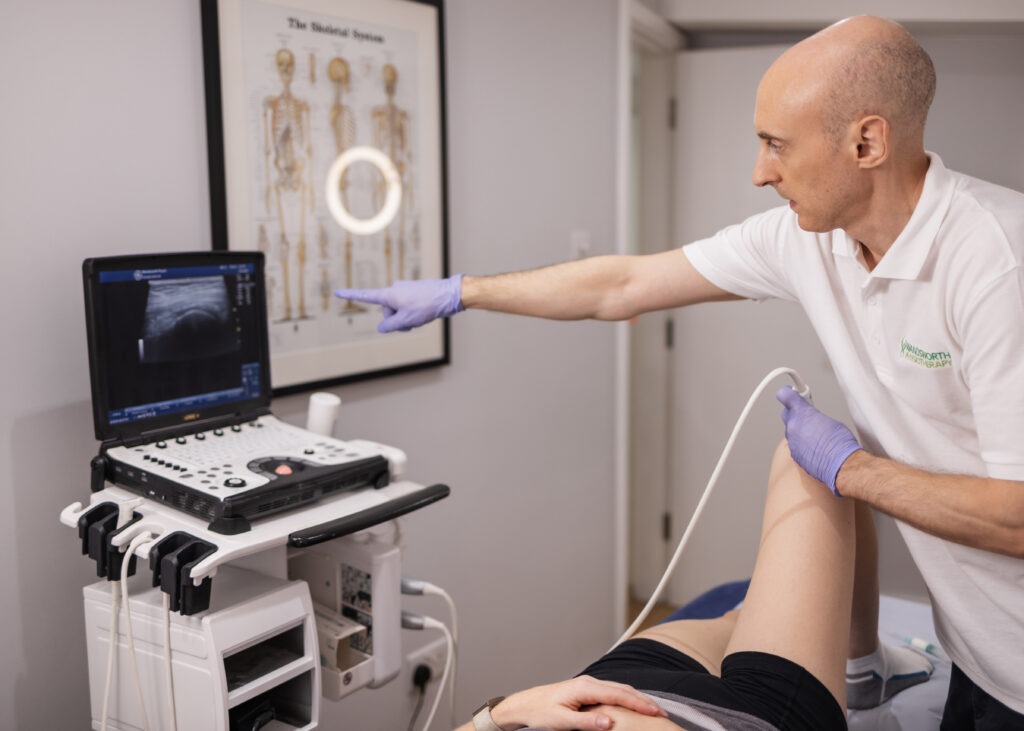
At Wandsworth Physiotherapy, we have clinicians who are dual-trained physiotherapists and MSK sonographers.
This means diagnostic ultrasound can often be incorporated into your clinical assessment rather than requiring a completely separate referral elsewhere.
What can an ultrasound scan show?
Diagnostic ultrasound allows us to examine the Achilles tendon in real time.
We can assess:
- Tendon thickness
- The normal fibrillar structure of the tendon
- Areas of altered tendon structure
- Vascularity using Doppler ultrasound
- The tendon insertion
- Surrounding soft tissues
- Fluid or bursae
- Possible partial or complete tendon tears
We can also examine the tendon dynamically while moving the ankle.
Crucially, we interpret these findings alongside your clinical assessment.
An “abnormal” looking tendon on a scan does not necessarily mean you need aggressive treatment, and changes on ultrasound don’t always correlate directly with the amount of pain someone experiences.
The scan is therefore one piece of the diagnostic puzzle rather than the whole answer.
If you think you may benefit from an ultrasound assessment, mention this when booking so we can ensure you see an appropriately qualified clinician and allow enough time for the appointment.
How do you treat Achilles tendinopathy?
There is rarely a single quick fix.
The cornerstone of successful Achilles treatment is usually progressive loading and rehabilitation.
The aim is not simply to make the tendon stop hurting. We want to increase its capacity so that it can once again tolerate the demands you place on it.
For a runner, that ultimately means getting the tendon strong enough to cope with running.
1. Managing your running load
Complete rest isn’t always necessary.
In fact, completely unloading the tendon for a prolonged period can reduce its capacity further.
Instead, we usually look at modifying the activities that are aggravating it.
This could mean temporarily reducing:
- Running mileage
- Running frequency
- Hill running
- Speed work
- Plyometric exercise
- High-impact sport
You may be able to maintain cardiovascular fitness through cycling, swimming or another activity while gradually rebuilding your running.
The aim is to find the right level of loading – enough to stimulate adaptation without repeatedly flaring the tendon.
We have a specific running injuries clinic and offer A Run Fit assessment, where your running technique and training programme is assessed and refined.
2. Progressive calf and Achilles strengthening
Exercise is the most important part of Achilles rehabilitation.
You may have heard that eccentric heel drops are the “best” exercise for Achilles tendinopathy. They can certainly be useful, but modern rehabilitation isn’t limited to one type of exercise.
Depending on your symptoms and stage of rehabilitation, we may use a combination of:
- Isometric calf exercises
- Slow calf raises
- Bent-knee soleus exercises
- Heavy slow resistance training
- Progressive single-leg calf strengthening
- Plyometric exercises
- Hopping and jumping
- Running-specific drills
As your tendon becomes stronger, the exercises need to become progressively more demanding.
There is little value in being able to complete lots of easy calf raises if your ultimate goal is to run a marathon, sprint, play football or return to tennis.
Your rehabilitation needs to prepare your Achilles for your sport and your goals.
Shockwave therapy for Achilles tendinopathy
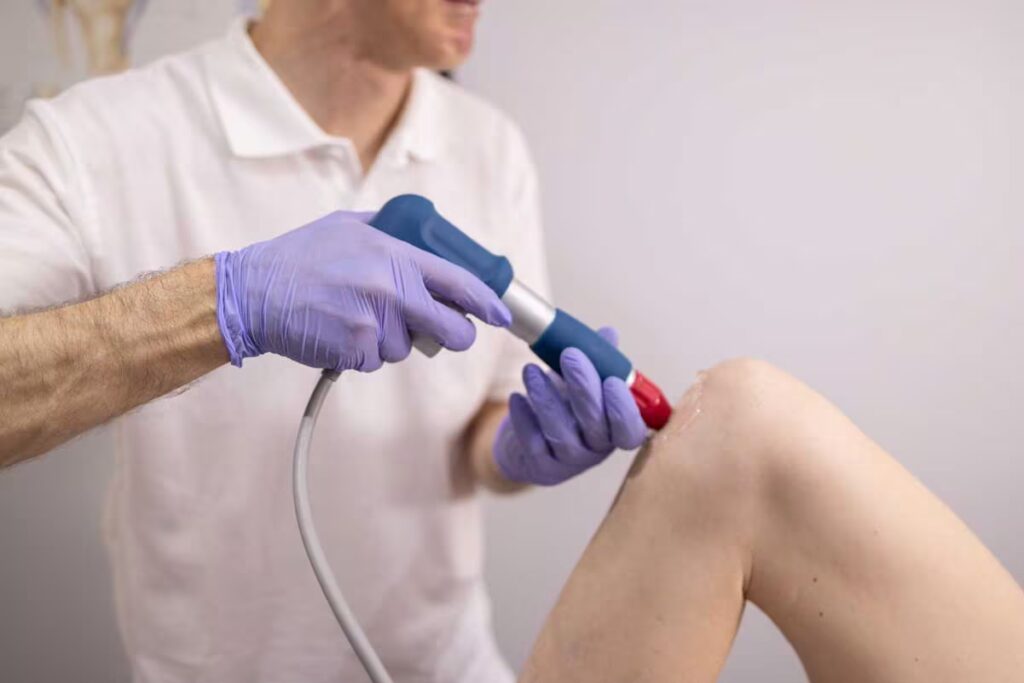
For persistent Achilles tendinopathy, we may recommend extracorporeal shockwave therapy (ESWT) alongside rehabilitation.
Shockwave therapy delivers mechanical acoustic impulses to the affected area using a handheld device.
It is a non-surgical treatment and is commonly considered for longer-standing tendon problems that haven’t responded sufficiently to exercise and load management alone.
At Wandsworth Physiotherapy, shockwave is not used as a replacement for rehabilitation.
Instead, where appropriate, we use it as part of a combined programme alongside progressive strengthening and careful management of your running or sporting load.
Could my feet or running biomechanics be contributing?
Sometimes.
There isn’t one particular “bad” running style or foot shape that causes Achilles tendinopathy in everybody.
However, biomechanics can influence how load is distributed through the lower limb.
For someone with recurrent or persistent Achilles problems, it may therefore be useful to consider factors such as:
- Foot posture
- Ankle mobility
- Calf strength
- Lower-limb alignment
- Running gait
- Footwear
- Training surfaces
- Previous injuries
This is where working alongside a podiatrist can be particularly valuable.
Podiatry, gait assessment and orthotics
Wandsworth Physiotherapy offers podiatry alongside physiotherapy, allowing us to take a multidisciplinary approach when appropriate.
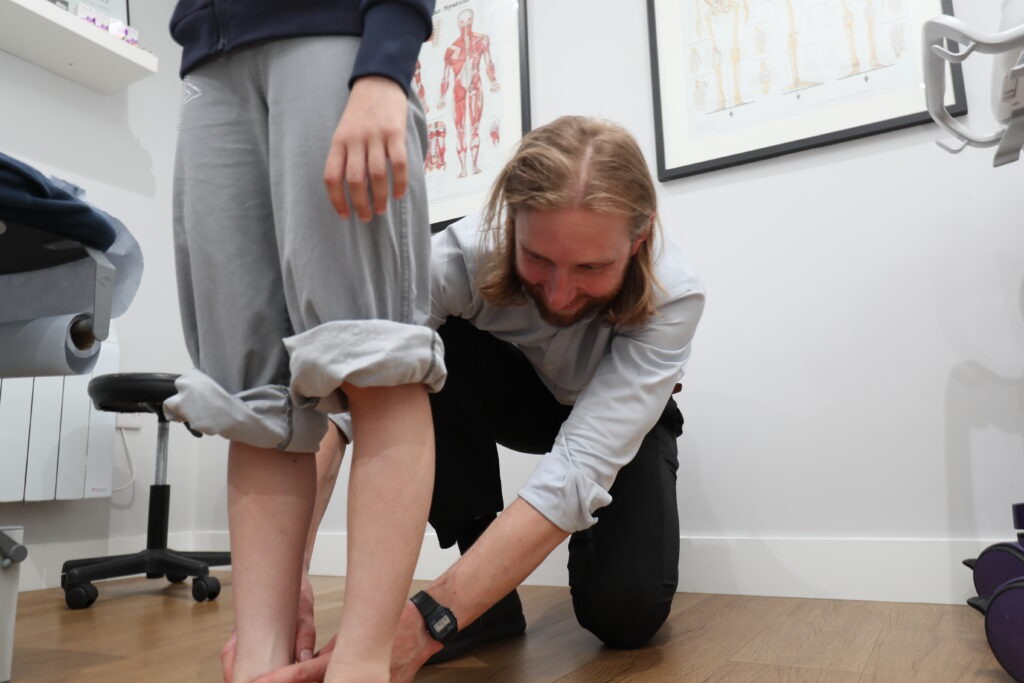
A podiatry assessment may look at your foot and ankle mechanics, footwear and how you walk or run.
For some people, modifications to footwear or temporary use of a heel lift may help reduce load or compression through the Achilles while symptoms settle.
In selected cases, orthotics may also be considered.
However, orthotics aren’t something that everybody with Achilles pain automatically needs.
The decision should be based on your individual biomechanics, symptoms and clinical findings rather than simply prescribing insoles because your Achilles hurts.
Can I continue running with Achilles tendinopathy?
Often, yes – but it depends on the severity of your symptoms.
One of the biggest mistakes runners make is using pain during the run as their only guide.
Your Achilles may warm up beautifully and feel almost normal after ten minutes.
The more useful question can be:
“How does it feel the following morning?”
If your morning stiffness and pain are progressively worsening after each run, your current running load is probably exceeding the tendon’s capacity.
We can help you establish an appropriate level of running and gradually build from there.
How long does Achilles tendinopathy take to recover?
This varies considerably.
A relatively recent problem that is identified early may improve much more quickly than a tendon that has been painful for many months.
Achilles rehabilitation often requires patience because tendon adaptation takes time.
Rather than promising a quick fix, we focus on measurable improvements such as:
- Reduced morning stiffness
- Less pain
- Improved calf strength
- Better single-leg calf raise capacity
- Increased hopping tolerance
- Increasing running volume
- Greater confidence in the tendon
The ultimate aim is not simply to get you pain-free walking around the house.
It is to restore enough strength, capacity and resilience for whatever you want to return to; whether that’s a weekly 5K, your first marathon, football, tennis or simply walking comfortably.
Achilles pain treatment at Wandsworth Physiotherapy
Achilles tendinopathy is a common running injury, but there isn’t one treatment that is right for everybody.
Successful treatment starts with establishing what is causing your pain and why your tendon may have become overloaded in the first place.
At Wandsworth Physiotherapy, we can bring together:
- Specialist physiotherapy assessment
- Running injury rehabilitation
- Diagnostic musculoskeletal ultrasound
- Progressive strength and conditioning
- Shockwave therapy
- Podiatry
- Gait assessment
- Footwear and orthotic advice where appropriate
- A structured return-to-running programme
This multidisciplinary approach allows us to look beyond the painful tendon and address the factors that may be contributing to the problem.
If your Achilles pain is stopping you from running or simply isn’t getting better, book an assessment with our team.
And if you think an ultrasound scan may be helpful, mention this when booking so we can make sure you are booked with an appropriately qualified clinician and enough time is allocated to your appointment.
FAQs
Can I keep running with Achilles Pain?
Often you can continue some running, but your training load may need to be reduced or modified.
Your response later that day and the following morning can be particularly useful in judging whether the tendon is tolerating your current training.
A physiotherapist can help you establish an appropriate starting point and gradually increase your running as tendon capacity improves.
What is the fastest way to heal Achilles tendinopathy?
There isn’t usually a single quick fix to Achilles Pain.
Progressive tendon loading and calf strengthening are central to rehabilitation, combined with appropriate management of running and other activities.
Persistent cases may benefit from additional treatments such as shockwave therapy, while podiatry or gait assessment can be useful when biomechanics or footwear may be contributing.
Is walking good for Achilles tendinopathy?
Walking can usually be continued if symptoms remain manageable, although the appropriate amount will depend on the severity of the problem. If everyday walking significantly increases your pain or morning stiffness, the tendon may need a temporary reduction in load.
Does Achilles tendinopathy show on an ultrasound scan?
Ultrasound can demonstrate changes such as tendon thickening, altered tendon structure and vascularity and can help identify associated problems or tears. However, imaging findings need to be interpreted alongside your symptoms and physical examination because structural tendon changes can also be present in people without pain.
Does shockwave therapy work for Achilles tendinopathy?
Shockwave therapy may be considered for persistent Achilles tendinopathy, particularly when symptoms haven’t responded sufficiently to an appropriate rehabilitation programme. At Wandsworth Physiotherapy, it would normally be used alongside progressive strengthening rather than instead of exercise.
Should I see a physiotherapist or podiatrist for Achilles pain?
Physiotherapy is usually a good starting point because rehabilitation and progressive loading are central to Achilles treatment.
Podiatry can add useful information where foot mechanics, footwear or gait may be contributing.
At Wandsworth Physiotherapy, the advantage is that physiotherapy, podiatry, diagnostic ultrasound and shockwave therapy can form part of a joined-up treatment plan.